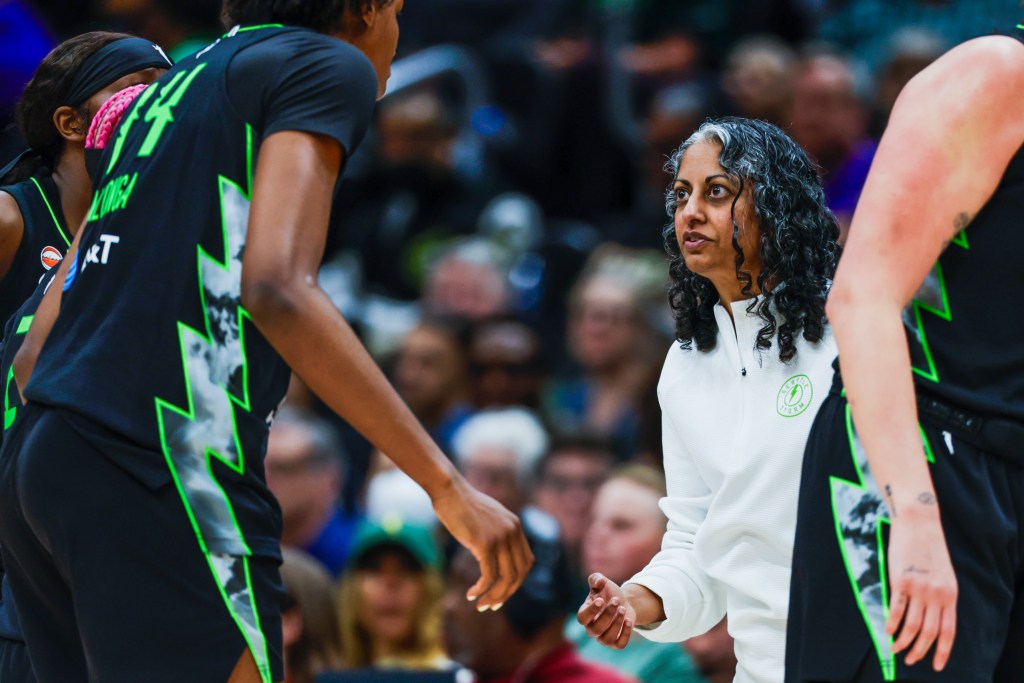
Most people judge a team and coach’s success by their win-loss record, and the Storm’s was the worst in the WNBA by far this season, at 8-36. But first-year head coach Sonia Raman and the Seattle Storm did not enter this season planning to use that as a measure for evaluating the team’s success or Raman’s success as a head coach.
“We obviously knew coming in that we were a really young team and a really new staff, and so there was going to be a lot of room to grow and improve. And I think that’s how we’ve measured success is really from where we started at the beginning of the year to where we are now,” Storm general manager Talisa Rhea told The IX Sports. “I think that we’ve laid a really solid foundation for what’s to come. And so, I would view that as a success for this season, and excited for it to continue.”
Rhea acknowledged that, of course, they are in a sport where wins and losses matter, but feels it is important to take a step back and look at and evaluate based on the bigger picture. That bigger picture? Getting the Storm back to competing for a championship.
“I think this was the first step in that was getting a really good core group of young players that are really talented and giving them the time on the court to gel together, to develop, to learn, to just experience playing WNBA basketball game in and game out, and to step into different roles than they have been,” Rhea said. “So that’s really what this year has been focused on … knowing that you can’t skip steps along the way.”
What Raman wanted to see was her team playing with consistent effort every night, playing hard, playing together and seeing improvement, she told The IX Sports. And she feels like she saw that.
“I think that we’re all really proud of the culture that we have established here,” Raman said after their final game of the season. “This group is really connected. They work really hard. They’re resilient. They don’t quit.
“When you have a culture like that, it’s really easy to take steps forward because we don’t have to worry about that part,” Raman continued. “We just have to keep strengthening it, and then we just have to get better at some of the details on our execution, our schemes, making shots, you know, all these details. But the foundation is there, and the culture is there, so I’m really proud of that … and all the steps forward we took on the basketball court.”
The majority of Raman’s players heartily agreed that she did a good job in her first year as a professional head coach — having previously been the head coach at MIT and an assistant in the NBA and WNBA — considering the circumstances.
“I think it’s hard to come in this league as a first-year [pro head] coach; you have a lot to learn, and I feel like she embraced that,” second-year center Dominique Malonga told The IX Sports. “She was really listening to everything, to the feedback. Really open to conversation. I think that’s great. I think that’s the best thing you can have when you’re coming in. So I think she helped us keep this team together and create that chemistry until the end of the year.”
The reality facing Raman entering the season was a radically shortened offseason that didn’t allow her to really know her roster until a few days before training camp, a historically young starting lineup and most players in very new roles.
At 29 years old, point guard Natisha Hiedeman was the oldest starter after spending the past two years as a scoring punch off the Minnesota Lynx bench. Jade Melbourne was most often the one beside her, still 24 years old and starting consistently in the WNBA for the first time in her career. Rookie shooting guard Flau’jae Johnson, 22, was acquired in a shocking last-minute draft day trade. Awa Fam, the No. 3 overall pick in 2026, joined the team late, still just 19 years old. And 20-year-old Malonga was expected to quickly step into the role of a star scorer in her second year. Their established franchise veteran, Ezi Magbegor, missed most of the season to injury and then suffered an ACL tear in the FIBA World Cup.
“For [Rahman] to be able to take on the Storm this year, a very new, young team, I think she did a great job in letting people play and letting people get a feel for their game in the W as well,” veteran center Magbegor said in her exit interview. “I think it’s not easy to be a head coach in the W, and so for her to be able to be confident in her role and instill that confidence in us as well was really important.”
Listen now to The IX Sports Podcast and Women’s Sports Daily
We are excited to announce the launch of TWO new podcasts for all the women’s sports fans out there looking for a daily dose of women’s sports news and analysis. Stream on Spotify, Apple Podcasts or anywhere you listen to podcasts, and make sure to subscribe!
“I mean, obviously we didn’t win a lot of games, which sucks, but we were in a lot of games with really close margins,” veteran center Stefanie Dolson said. “We had expectations, but I think our expectations were to build a foundation and to grow on them, and I think we did that, and I think that’s an achievement in itself. So I think for Sonia, I hope she can be proud and happy with herself with the season that she had. It was a pleasure to play for her.”
Evaluating growth
Growth was the biggest focus of the season; so, how did individual players and the team as a whole improve? Their last game of the season, a 103-91 home loss to the playoff-bound Dallas Wings, was a strong showcase of both levels of improvement for the team and where they need to continue to get better.
Individually, their young big three of Malonga, Fam and Johnson all scored over 20 points in the same game for the first time. Malonga showed the next step in her evolution as an MVP-caliber player by leading the team with 29 points. Fam showed how she has found her footing with a career-high 22 points. Johnson continued her strong end to the season with 21 points and added four assists as she has worked on her passing all year.
“She really helped me in this new role of mine, being a leader of this team,” Malonga praised. “She really guided me into that naturally. She gave me a lot of responsibilities, but also a lot of freedom. I think that helped. She trusted me, and I’m really grateful for that.”
Johnson similarly expressed how grateful she was to Raman in her exit interview, particularly for allowing her to gain the experience she did.
“Experience is the best teacher, and I feel like it has allowed me to be light years ahead of where I could have been,” Johnson said. “She gave me so much opportunity, gave me so much responsibility, and she had so much patience with me, and I think that’s one thing that I really appreciate.
“I was a good player, but there were still areas I was not well in … and she saw how hard I work and she just supported that and coached me and used all those things to together. And for me it just really helped my confidence so I’m thankful for her for that.”
Hiedeman also grew into her role as a starting point guard, averaging career-highs across the board and finishing with a career-high 14 assists against Dallas. Zia Cooke and Melbourne also saw career-highs across the board. Katie Lou Samuelson and Jordan Horston impressed at various moments as they worked their way back from ACL tears that caused them both to miss the previous season.
Raman gave credit to her assistant coaches for the day-to-day work of watching film with players, doing the on-court development work, keeping their confidence high, and helping them understand what the team is looking for. But assistant coach Natalie Achonwa said that individual development starts with Raman’s determination to focus on growth and carve out time for it.
“I think that her mentality of that has been instilled in all of us as a coaching staff,” Achonwa told The IX Sports. “I think to be able to truly develop, grow and expand, you need to have a lot of different viewpoints. And I think she built a staff that really has that: different levels of experience, different professional careers, and just different viewpoints on what growth looks like, and I think collectively we have really poured into the development, and you’ve seen it in the skill set that has continued to get better throughout the entire summer.”
The assistants do a lot of the hands-on development work on the court, but Achonwa pointed out that the conversations about what they are building and focusing on come from Raman. Meanwhile, Raman heavily praised her assistants for how they collaborated with her every day.
It is valid to question if the individual development comes more from the playing time than the head coach. But Rhea thinks the preparation of the team and how Raman is able to help put the players in positions to be successful are indicative of her impact. For Raman, putting players in positions where they can develop is key.
“Does the offense allow for Dom to handle the ball a little bit? Does the defense allow for Jordan [Horston] to switch a little bit? What is different about Flau’s game now than the beginning of the season? … All the different ways that we can move Awa around the court,” Raman explained. “So I think as a head coach it’s more about: does the offense allow for those improvements? Does the defense allow for those improvements? …
“Of course, a lot of them are playing way more minutes than they’ve played in the past, and so growth happens from that. But it doesn’t happen without all the intentionality that happens behind the scenes, and huge credit to this organization for what they’ve been able to do with that too.”
The individual growth goes hand in hand with team growth. Players need to continue to improve for the team to be successful, but the potential of each player is also affected by how they best fit alongside each other.
On the team level, the loss to Dallas showcased a clear vision of Storm basketball, but the team struggled to put it together for a full 40-minute game. Raman felt that the second quarter, where they outscored the Wings 30-20, was particularly indicative of how they want to play — getting defensive stops to fuel their offense, being active and sharing the ball (10 assists on 13 made field goals). They put it together for a good chunk of the game, but not long enough, as defense let them down.
At shootaround before the game, one of the performance indicators Raman pointed to improvement in was the offensive end.
“I’m seeing more of a process that’s leading to better shots,” Raman said. “I think our shot quality was strong this season. I think that we generated the catch-and-shoot open threes that we wanted. We were generating shots at the rim — I think we could probably generate more of those. And just trying to get our spacing to the point where we can generate those was the improvement right there, and also just playing at a quick pace.”
After the game, Raman again pointed to those markers, particularly pace. They started with one of the slowest paces in the league and finished one of the fastest. Defensively, in the team’s better segments, she praised the connectedness, physicality and shot quality they forced.
The game particularly showed how the team chemistry has improved cumulatively over the course of the season on both ends of the floor.
“I think it really showed up today,” Raman said of the team’s chemistry. “You saw how they were able to play off each other, use each other’s strengths, use the gravity that each of them has to then create for someone else or for themselves. And that’s the vision.”
Dolson, a 14-year league veteran, agreed that the team got better at learning to play together and play the right way.
“I think coming into it, our defense wasn’t the best. We didn’t have a lot of assists; I think it was a lot of one-on-one. And I think our team has gotten a lot better with just moving the ball, finding the right pass, making the right decisions. They are young, so I think it was reading the game as well,” Dolson told The IX Sports. “And I think, although obviously our record hasn’t shown it, there’s been a lot of growth in reading the game and where our advantages are and taking advantage of those. For that, I’m really proud of them and for Sonia to be able to teach that.”
Raman feels she saw defensive improvement but acknowledged in her exit interview that it wasn’t consistent across games. Even with a middle-of-the-league defensive rating, giving up too many points was what lost them many games. In addition to the inconsistency, Raman pointed to issues specifically with transition defense, defending without fouling, and defensive rebounding. She felt the rebounding improved in the second half of the season while free throws and easy buckets in transition continued to plague them. Being without Magbegor for most of the season, a perennial Defensive Player of the Year candidate, certainly didn’t help.
“Becoming Caitlin Clark” is out now!
Howard Megdal’s newest book is here! “Becoming Caitlin Clark: The Unknown Origin Story of a Modern Basketball Superstar” captures both the historic nature of Clark’s rise and the critical context over the previous century that helped make it possible, including interviews with Clark, Lisa Bluder (who also wrote the foreword), C. Vivian Stringer, Jan Jensen, Molly Kazmer and many others.
Beyond those, another area she hopes to improve next season is being able to dial up a stop when they need it, something that haunted them in close games. Additionally, some of the league’s best scorers had career performances against the Storm, so she wants to bring those numbers down. Raman also wants to add different coverage options because, in 2026, she said they kept it simple so the team could fly around and be more active. Overall though, Raman knows the team needs to be better in all areas defensively and there is plenty of room for improvement on both sides of the ball.
“I think that we did a really good job of playing hard and playing together and getting better. And there’s still a long way to go,” Raman said. “I think that they can all be really proud of the steps that they took forward, and for them to take those steps forward individually, then allows for the team success, the organizational success, and the sustained success that we are planning to have.”
That improvement across the board is what Raman and Rhea feel is missed if judgment is made solely on the win-loss record.
Playing with joy
As hard as a losing season is for fans, it is even harder on players. Knowing results would be hard to come by, the mentality Raman sought to instill through the season was key to allowing growth to continue.
“I think her as the head coach and the way her demeanor is, it was very like ‘it is what it is, we’re going to move on and we’re just going to keep getting better,’” Dolson explained. “She didn’t come in frustrated. She didn’t come in like she’s going to kill someone. She was very steady, and I think that kept us in a good place to not get too frustrated or not get too excited.”
Melbourne said the way Raman came in from day one, laying a foundation for the culture they wanted to cultivate, set the tone for how the team stuck together throughout a tough year.
Achonwa said Raman came in and made her mark her way with the attitude she brought that was exemplified by the ‘play with joy’ Playa Society t-shirt collaboration, which was a team favorite, according to Melbourne.
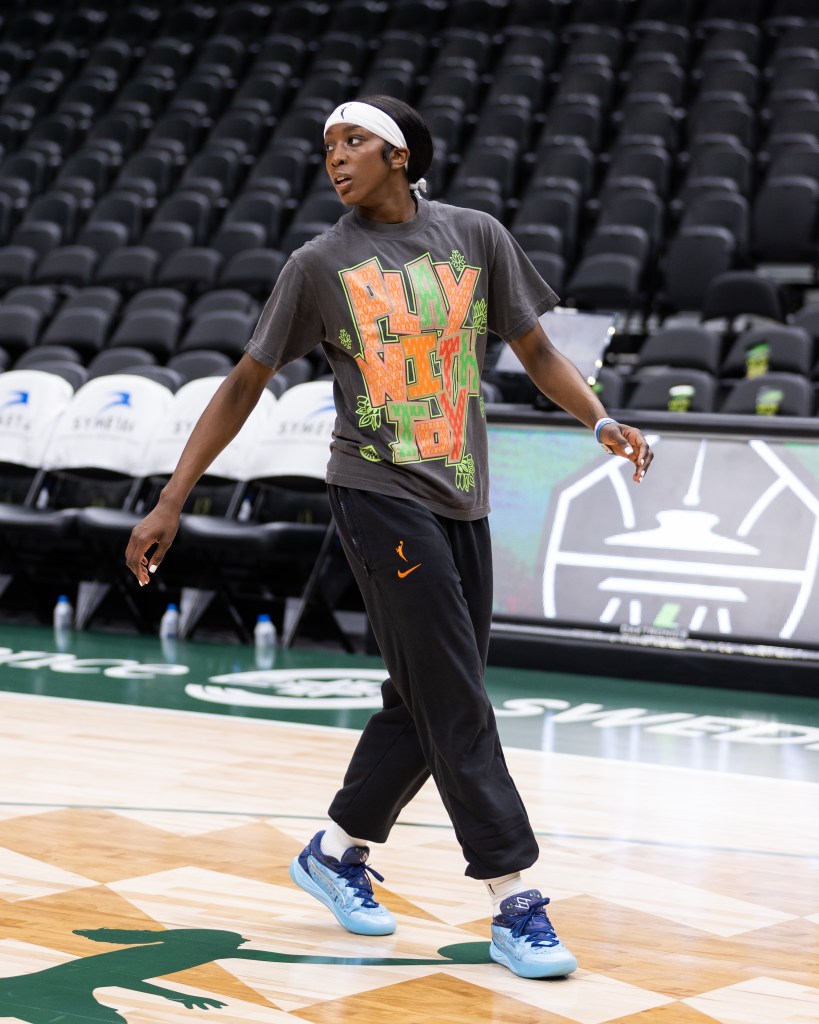
“I think her bringing that into the environment of like, no matter what, we’re playing basketball, we’re going to do it the right way, we’re going to build in the process, we’re going to trust in the process — I think to have that as a leader is really important with such a young group,” Achonwa said.
After her three stars beamed through their last postgame presser despite the loss, Raman emphasized how important she feels it is that they have maintained that joy throughout the season.
“It’s a credit to them because they have that next-play mentality. But they’re not up here smiling and happy at the end of the game after a loss, typically, and that’s important too. They really want to win; they’re really hungry for that. But they can also take a step back and have perspective of, ‘look at how much better we’ve gotten and look at what we have ahead of us,’ being as young as we’ve been this season,” Raman said.
In her exit interview, Malonga confirmed that Raman’s positivity was “everything” in helping the team get to the point they are at through a tough, losing season.
“That’s what gets us being in that gym every day and staying locked in and growing,” Malonga said. “I think that’s my biggest takeaway this season is that despite everything, we always had fun, and we always enjoyed playing together.”
The mentality Raman brought all year is part of why Hiedeman has thought at times that this is not how she wanted Raman’s first year as a head coach to go for her.
“She continued to show up, she continued to believe in us, continued to trust us and she’s a really good person,” Hiedeman said in her exit interview. “I think that if you’re a good person, good things are going to happen. So I think that her coaching career is going to be great for her because of just the person that she is.”
Player-first approach
Integral to the impact Raman was able to have is the way she cares about her players as people first, a trait that was repeatedly praised when she was hired.
“I think Sonia’s taken a relationship-first approach to coming in as a new head coach with her staff, but also with the players, and I think we’ve really felt that,” Rhea said. “I think she genuinely cares about them as people, which is critical to success for anyone. And so that’s been the foundation of what she’s come in and done. I think she’s done a great job of developing those relationships, and now it’s going to be to continue to build off of those and, you know, really push them forward.”
Cooke expressed at the very beginning of the season how much she valued the belief that Raman had in her and doubled down in her exit interview.
“I think this is the most confident I’ve been my whole four years in the W, and mainly it comes from just the belief and confidence that Sonia had in me,” Cooke said. “Not only does she talk about how much she believes in me, but she allows me to go out there and show it.
“We had a lot of conversations this year. Even when [there were] times where I felt like, ‘dang man, I think I can be getting more opportunity,’ she was super easy to go to have conversations with. We watched film together. She’s been super transparent with me this whole time. It’s been great to be able to be coached by her. But more than anything, it’s just been great to be coached by somebody that actually believes.”
Malonga felt Raman listened to everything they said, whether it was straight basketball conversations about how to improve, how her players were feeling on the court, or how they could improve getting to their spots. She wasn’t sure exactly how to explain it, but knew she valued how proactive Raman was in working with her players rather than just giving directions to be followed.
Fam similarly lauded the confidence that Raman continually instilled in her.
“She was always talking with me, [from] the first day that I arrived here she was like asking me the questions if I want to receive the ball inside, if I want to receive the ball outside,” Fam said in her exit interview. “She was just giving me that confidence that, okay, you can do whatever you want or whatever you feel more comfortable. And I think that’s the best thing for a coach: just give your players that confidence to play and just enjoy on court, so I’m just so happy for that.”
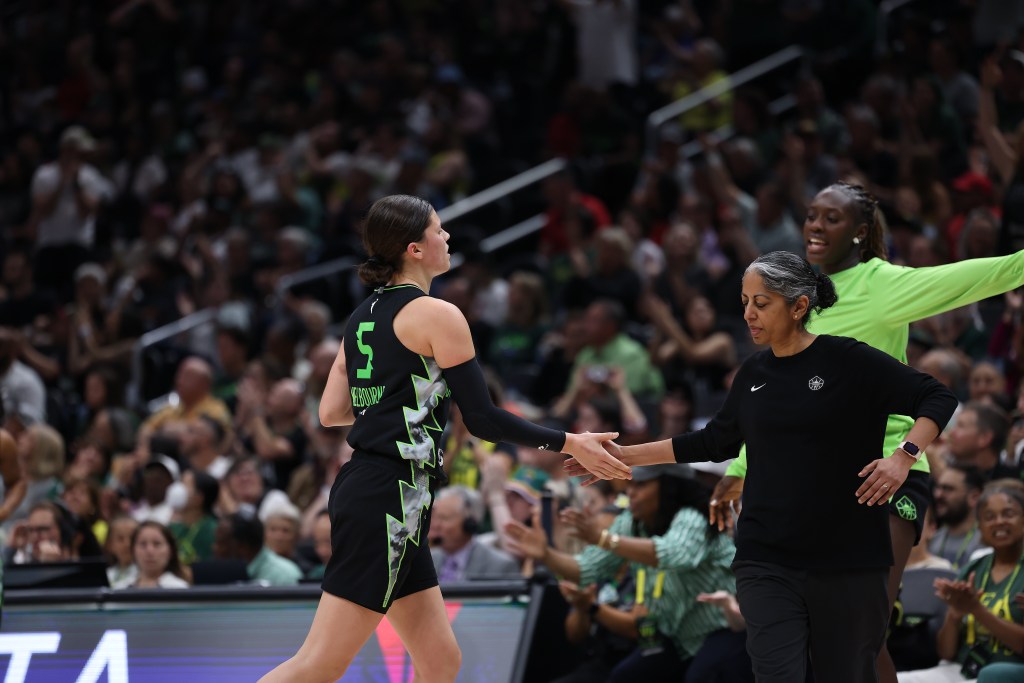
Hiedeman praised her really solid relationship with Raman, in which they communicated a lot and the coach put a lot of trust in her.
“Being more of a vet now, we had conversations that I think meant a lot to me,” Hiedeman said. “Just pertaining to the team, like, do you think we should do this or this? So I think our relationship is in a good place. I think that it’s going to continue to grow. The trust is there.”
Rep The IX Sports at your next game!

Shop the logo collection or special “Women’s Sports are Front Page News” collection now on Shopify.
Even Taina Mair, the lone player who stuck on a development contract with the Storm for the whole season, felt directly impacted by Raman in a positive way.
“I think it’s been great. She’s voiced to me where she thinks I can improve, and I think as a player that’s very helpful. Just being young in this league and knowing what areas I can improve in and being able to focus on that with the supporting staff, it means a lot to me,” Mair said. “Coming in, kind of a little bit different from everybody else when I only get to play like 12 games, knowing where I can improve is a great big deal.”
Teaching analytics
When Raman was first hired, her penchant for analytics was often cited as one of her strong suits. That showed up with the Storm in a multitude of ways, including her players praising her intelligence for the game.
Raman’s heavy use of statistics and analytics was very different from the way many of the players were used to being head coached, particularly Melbourne.
“As someone who didn’t go to college and doesn’t love school, at the start, I was pretty overwhelmed with all the numbers,” Melbourne laughed. “She was throwing out numbers at the start of the year; I was like, ‘Holy moly! There’s a lot of information, there’s a lot of data here.’ But it’s good. I needed to tap into that kind of stuff. … It’s a different approach, but I got comfortable with it. … I was asking for numbers in the end.”
Malonga feels that Raman’s analytical focus really helped her learn the game.
“She helped me learn to analyze the numbers more and to understand how it can impact the game too,” Malonga said. “Sometimes you watch a lot of film, but it’s also interesting to look at the numbers because what you see in film sometimes, and when you look at the numbers, you can see that it’s maybe not that bad. So I think that’s part of the game where you can find reassurance in the number sometimes and grow off of it.”
Dolson said the analytical side is what they saw the most. Raman always had the stats, both basic and those you wouldn’t even know about. Utilizing that data is also a way that Raman kept her team focused on growth areas.
“To see the growth through the numbers is really cool, and for us they were where we found little wins as well,” Melbourne said of how they looked beyond the win-loss record.
Growing as a coach
Raman expects her players to grow, and she expected herself to grow into her new role as well. After the final game, the head coach said that she learned a lot about herself this season. One thing, which was less of a new lesson and more of a reminder, is that she doesn’t know everything.
“Being open, listening, leaning on my staff as much as I can, talking to the players, just constantly trying to make sure that this is a collaborative effort, and we do this as a group, and we do this together,” Raman said. “That way we have the buy-in of everybody, and we’re pulling together as one unit, moving forward, trying to attack the opposing team. … Being a head coach in the pros is something I haven’t done before, and so just kind of making sure I remember that I don’t know those things, and that there’s going to be things that are coming, and really try to stay ahead of those as much as I can.”
Achonwa felt that in how Raman’s trust and belief in her staff grew throughout the year.
“I think at the beginning we were all new to each other. We don’t know each other, and I think we just sat in the room. We were like, ‘Okay, who’s gonna do what?’” Achonwa explained. “And I think her openness to teach, but also to learn, and for us to work together collaboratively has been great as we continue to go throughout this year. And I think like just the check-in points on like how can I be better, how can you be better, and our ongoing conversation has been very like uplifting to feel.”
Raman wasn’t the only one tackling a new situation. Achonwa said there was a learning curve for the entire staff from the beginning. They had to figure out the best way to help the players — who were both mostly new to each other and young — learn and absorb information.
“It’s not what works for one player is going to work for the other,” Achonwa said. “Trying to bring them along one by one and trying to — whoever needs more gets more, whoever needs less, or it’s spoken in a different language in a different way gets that — that’s how you bring an entire group, is meeting the players where they are.”
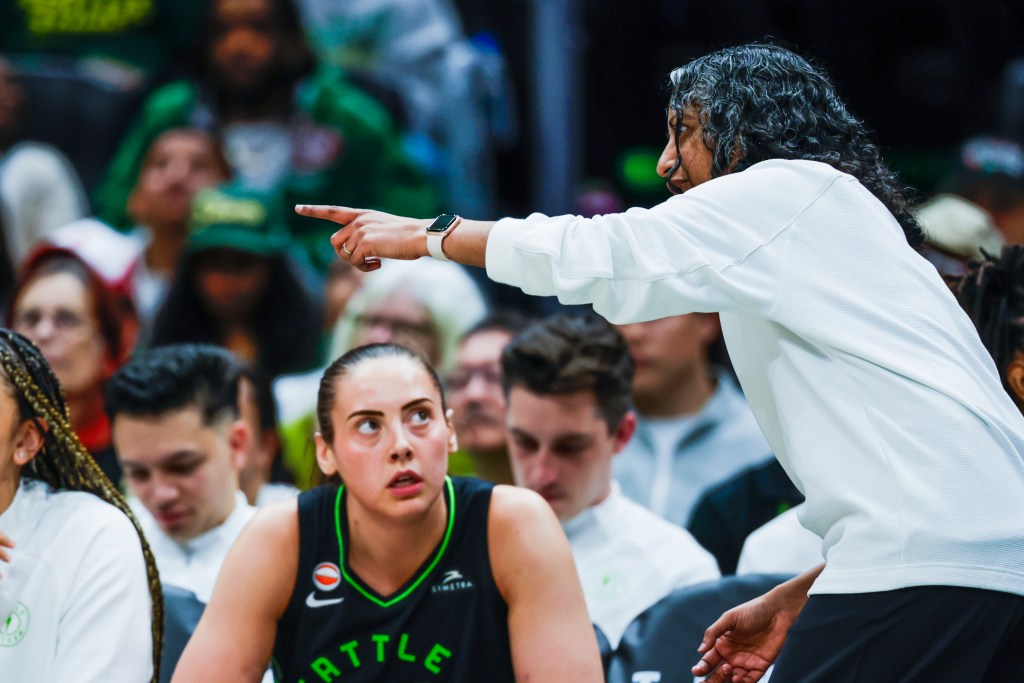
Raman also learned this season just how compressed the games are; with high density of teams and travel, there’s not a lot of time in between. That makes it particularly difficult to figure out how to best utilize time to develop players as individuals and the team as a unit, especially with a young team that needs more individual development time than veterans.
Rhea said she saw growth in Raman’s confidence as a leader through a high cadence of games, balancing moving on to the next with looking back to get better. Along those lines, Dolson noticed Raman using her voice more throughout the season.
“I think in the beginning, because she’s so analytical and stuff, she tended to lean more towards data. Whereas I think midway through it was kind of like she used her voice a little bit more. She kind of stood her ground a little bit more, as a head coach needs to do,” Dolson said. “I think she was more verbal about what she wanted from people and what she wanted to see, and teaching the game a little bit more with film and stuff, and I think that was really important for us.”
Raman said there are still so many things she wants to get better at individually. She didn’t have the time in exit interviews to delve into specifics but said she examines it constantly and would be particularly reflective during the offseason after she was able to ask the players in their meetings how she can be better for them.
Expectations for year two
For all these reasons, Raman will get at least one more season to prove herself as a WNBA head coach. Rhea declined to share any contract length details but said, “We’re really excited for the future with Sonia and for her to continue to grow with this group. And I think she’s done a great job of really helping us build the foundation for what’s to come.”
In year two, the stakes will be higher, though. For one, there will be some more certainty about and familiarity with the core group they have to work with. Thus, ideally, a better understanding of how to best utilize them. Raman will also be able to be more involved in conversations about how to make the roster better by adding players who fit her vision and style of play in a full-length offseason.
The players that Rhea wants to target a la Raman’s style are “versatile, high IQ, the ability to make adjustments, read and react … players that are tough, that want to play high tempo, and on top of all of that, just great people.”
Within that, and with an understanding that who is available will dictate some of the moves, the Storm will have to balance the young core they already have with wanting veteran talent.
“It is a balance of continuing to provide space for this group to grow and for it to be an organic process that takes some time, but also wanting to get as much talent in here and make that process as quick as we can,” Rhea said.
The Storm can’t get ahead of themselves. Even the Aces’ back-to-back-to-back No. 1 overall picks of Kelsey Plum (2017), A’ja Wilson (2018) and Jackie Young (2019) didn’t win their first championship until 2022. The organization and players understand they have to manage the high expectations for their future with the reality that even the best players in the world very rarely find immediate success.
“It takes time even for the greats; it took time for Michael Jordan,” Johnson said of the lesson she took from LSU assistant coach Bob Starkey, who coached Seimone Augustus and Sylvia Fowles long before their success with the Minnesota Lynx. “So I think that’s my mindset. I’m just going to be right where I am, and I’m just gonna let it develop. And … while I’m trying to become the player that I want to be, making sure that I make Dom better and make Awa better. And I feel like if I can do that, then we’re going to be exactly who we think we can be.”
So, to anyone who just looks at Raman’s win-loss record and disapproves of the decision to keep her on, Rhea says: “I think anyone who watches our group can see the excitement that is that core group, that young group that’s really talented, and I think with some more experience and that group continuing to work together, they’re going to be pretty special.”
‘Rare Gems’ is out now!
Howard Megdal, founder and editor of The IX Basketball and The IX Sports, wrote this deeply reported book. “Rare Gems” follows four connected generations of women’s basketball pioneers, from Elvera “Peps” Neuman to Cheryl Reeve and from Lindsay Whalen to Sylvia Fowles and Paige Bueckers.
If you enjoy Megdal’s coverage of women’s basketball every Wednesday at The IX Sports, you will love “Rare Gems: How Four Generations of Women Paved the Way for the WNBA.”