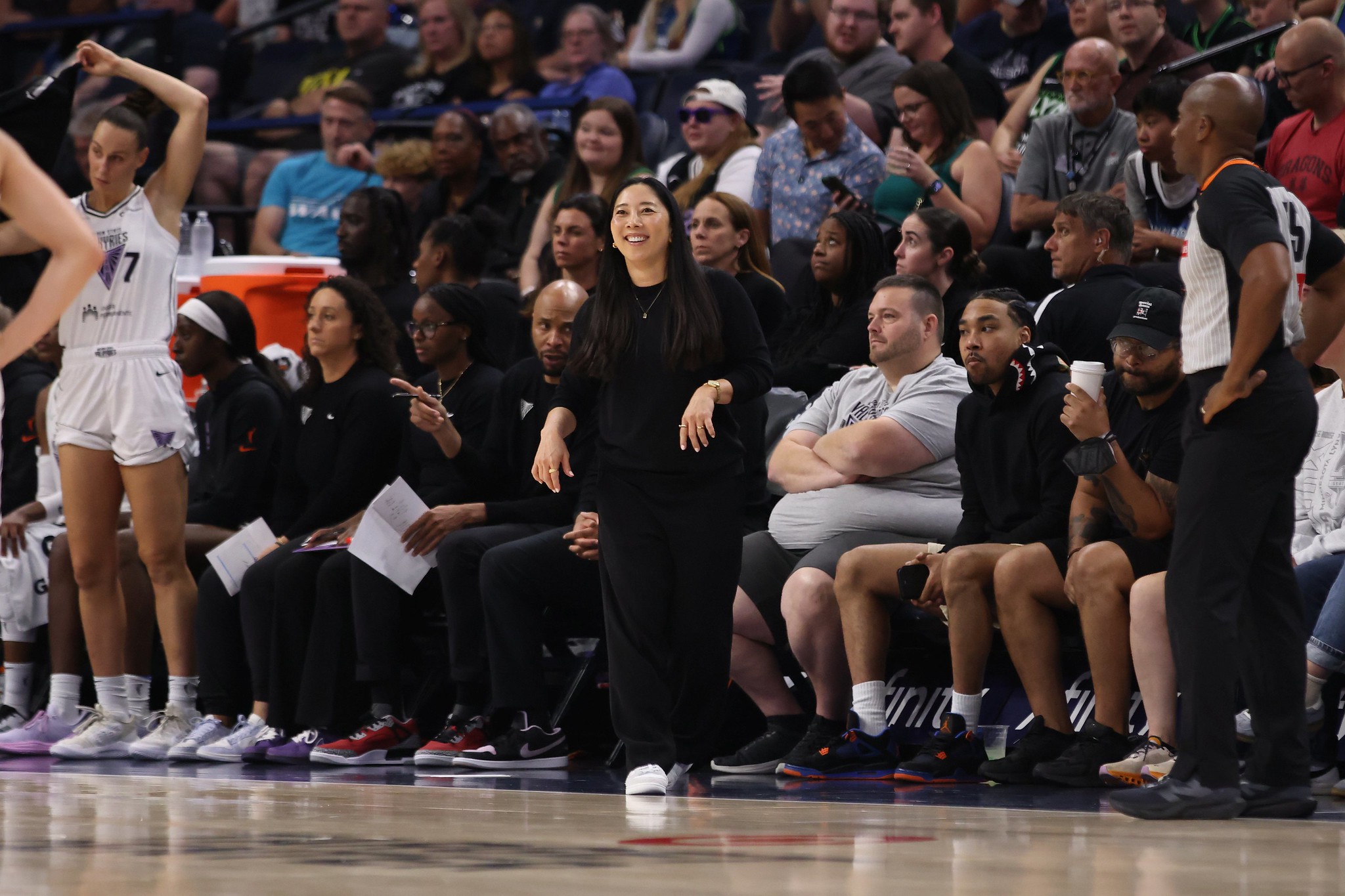
Natalie Nakase has built the Golden State Valkyries around the constants of defense, effort, accountability and selflessness—but the Valkyries’ response to adversity in the WNBA FInals has revealed that identity is fixed.
It is the foundation that has allowed the Valkryies to stay in the hunt for a title.
With the WNBA Finals tied 2-2 and heading back to San Francisco for a critical Game 5 in this best-of-seven series, Golden State’s second year head coach is learning and applying the most important lessons: there isn’t one way to win a game. Adjustments are required. And a two-game losing streak doesn’t define a team.
For most of the season, Nakase has spoken about the Valkyries’ identity in a limited number of terms. Defense. Defense into offense. Strength in numbers. Empty the tank. When they struggle, particularly offensively, Nakase’s explanation rarely begins with shot selection or execution. It begins a reminder about how defense comes first, about effort and fight. The willingness for Golden State to find their way back to these things after nearly losing the plot after Games 2 and 3 against the Dream puts Golden State back in position to win a title.
Those two defeats, including the 26-point loss in Atlanta in Game 3, made it look like Golden State’s defining traits disappeared at exactly the wrong time. The Valkyries did not merely lose. They appeared disconnected from the version of themselves that had carried them to the championship series. They adjusted their way of out doing what they do best. No one saw that better than Nakase.
Rep The IX Sports at your next game!

Shop the logo collection or special “Women’s Sports are Front Page News” collection now on Shopify.
“I think Game 2 and 3 we kept saying, ‘we don’t recognize ourselves’,” Nakase said. “We’re undisciplined, and that was the thing is, again, the accountability piece with all the film sessions I think we did the past two days. Took accountability with the film and were just not happy with it.”
Nakase said she sat down individually after the back-to-back losses with her players and listened.
“I listen more with losses than wins because I need to know what they are thinking and feeling,” Nakase said. “Credit to our players. They are super vulnerable after losses. Like I mentioned before, we get even closer after losses because we learn from our lessons after losses.”
Her decision to change the starting lineup before Game 4 — inserting Tiffany Hayes and Kaila Charles while moving Ceci Zandalasini and Kayla Thornton to the bench — was a risk. It came after two consecutive losses and could have been interpreted as panic or desperation. She tighten the rotation and simplified the game plan instead of trying to “do a little bit too much,” as Nakase said after Game 3.
Instead, it became the latest expression of the team’s, and Nakase’s, core identity. It was change for the sake of getting back to who they are.
On Saturday, Hayes and Charles provided the upfront defensive energy Golden State needed for a strong start. Zandalasini and Thornton responded with productive minutes off the bench. Zandalasini, in particular, gave the Valkyries a spark, scoring 10 points and adding three steals in a little more than 18 minutes. She used just seven players to keep her best defenders on the floor.
“Just what it took to win,” Nakase said.
The changes worked because Nakase has built a team capable of accepting it.
2026 WNBA transaction tracker
“The best thing about our team is no one cares who starts, no one cares,” Nakase said. “People coming off the bench, doesn’t matter. We can do that because we have a really selfless team, ego-less team.”
Nakase did not abandon the Valkyries’ identity. She trusted it enough to adjust.
Identity is not a lineup. It is not a specific rotation or a style of play. It is a set of shared values. The starting lineup could change because the values did not.
That flexibility has put Golden State back in position to win a WNBA title. The Valkyries did not right themselves in Game 4 by pretending the previous two games never happened. Instead, Nakase and her players confronted what went wrong, took responsibility and adapted without losing sight of who they are.
That is Nakase’s influence. She demands everything her players have because she has created trust. In front of a microphone, she takes accountability, but she has made accountability collective. She asks her players to empty the tank, but she understands that sometimes a team has to rearrange itself to find another way to win.
And because they did, a championship that briefly seemed to be slipping away is back within reach.